
For much of my life, I confused being intelligent with being wise. Intelligence helped me win arguments. Wisdom eventually taught me that winning was sometimes the stupidest thing I could do.
Being Right Isn’t Always Worth It | Jon-David
I used to be very good at being right.
Exceptionally good.
Annoyingly good.
I could argue.
I could debate.
I could remember something you said six months earlier and introduce it into evidence like Perry Mason with highlights.
I had logic.
Facts.
Language.
Volume, when necessary.
And embellishment, when facts needed a little hairdresser zhuzhing.
If you got into an argument with me when I was younger, there was a very good chance I was going to win.
Unfortunately, there was also a very good chance you were going to hate me when it was over.
It took me years to understand that those two things might be related.
“I Was Right About the Tip. I Was Wrong About Everything That Mattered.”-Jon-David
I Thought Being Right Was a Virtue
When you’re young, being right can feel enormously important.
At least it did to me.
Right meant smart.
Right meant capable.
Right meant you couldn’t fool me.
Right meant I wasn’t weak.
And somewhere along the way, I developed the ridiculous idea that if I was correct about something, I had not only the right but perhaps the responsibility to make sure everybody else knew it.
I didn’t just want to win the argument.
I wanted you to acknowledge that I’d won.
There would be no quiet concession.
I required surrender.
Preferably notarized.
LISTEN: Jon-David’s outrageous serialIzed podcast of mobsters, Hollywood, hair salon life, rave culure, true crime, and unbelievable stories inspired by a life that rarely went according to plan.
Start listening to
THE MAFIA HAIRDRESSER CHRONICLES →

Then There Was Allison
Allison was one of my closest friends for about twenty years.
When she first moved to Chicago to manage the salon where I worked, her apartment wasn’t ready.
So I offered her my bedroom.
She and her Chihuahua, Isabella, moved in.
I slept on an Aerobed in my living room with my dog, Daughter.
Every morning Allison and I couldn’t get coffee and cigarettes into our hands fast enough.
We’d take the dogs downstairs to the park near my high-rise, sit on the curb around the fountain, drink coffee, smoke and silently intimidate cheerful neighbors who attempted conversation before we’d finished caffeinating.
She was smart.
Wickedly funny.
Snarky.
I adored her.
Which apparently didn’t prevent me from eventually humiliating her in public.
Allison Was Cheap
There.
I said it.
At least that’s what I thought at the time.
We had a group of friends who regularly went out for dinner.
And whenever the check arrived, I began noticing that Allison seemed to leave less money than everybody else.
A dollar.
Five dollars.
Sometimes more.
Instead of doing what a normal person might do—which would be either mentioning it privately or, here’s an innovative concept, minding my own business—I started monitoring her.
I’d crane my neck toward the check.
Watch what she put down.
Calculate.
Observe.
Remember.
I was building a case.
Apparently I was the FBI of gratuities.
Then One Night, I Prosecuted
I don’t remember every word I said.
I remember the result.
I unleashed.
Years of accumulated irritation about Allison being “cheap” came pouring out of me.
In front of our friends.
I embarrassed her.
And because I had spent so much time collecting evidence, I’m sure I presented an extremely persuasive case.
That was important to me then.
I was right.
Except now, when I remember that dinner, I don’t remember the numbers.
I don’t remember how much the check was.
I don’t remember what percentage she tipped.
I don’t remember what I ate.
I remember embarrassing my friend.
That’s what survived.




Connect with Us on Social Media





YES. IT’S REALLY CALLED
HOW I KILLED MY MOTHER
A funny, painful, and unexpectedly hopeful memoir podcast about mothers, sons, guilt, grief, forgiveness, and the unfinished relationships we carry with us – sometimes long after the people we love are gone.
LISTEN TO HOW I KILLED MY MOTHER→

I Was Right About the Tip
Let’s give Younger Jon-David his victory.
Maybe I was completely correct.
Maybe Allison was undertipping.
Maybe everybody else at the table knew it too.
Maybe my mathematical analysis was impeccable.
Congratulations to me.
I was right about the tip.
I was wrong about everything that mattered.
I was wrong to keep score.
Wrong to let resentment accumulate.
Wrong to publicly humiliate someone I loved.
Wrong to use my ability with words as a weapon.
And perhaps most importantly, I was wrong in believing that being factually correct excused cruelty.
It doesn’t.
Being Right and Doing Right Are Not the Same Thing
That took me an embarrassingly long time to learn.
You can be right about your spouse.
And cruel to them.
You can be right about your coworker.
And humiliate them.
You can be right about your friend.
And destroy the friendship.
You can be right on Facebook.
God help you.
And spend three days arguing with a stranger who will never change their mind.
Facts matter.
Truth matters.
But what you do with the truth matters too.
I hadn’t learned that yet.
I Had Another Problem: Winning Wasn’t Enough
This is harder to admit.
I wasn’t satisfied when someone finally said:
“Fine, Jon-David. You’re right.”
You’d think that would have ended it.
No.
Sometimes I’d continue.
I’d re-explain why I was right.
I’d point out the specific moment when the other person should have realized I was right.
I’d add supporting documentation.
Perhaps a visual aid.
I wasn’t looking for resolution.
I was looking for capitulation.
There’s a difference.
Resolution says:
Can we fix this?
Winning says:
Can I make sure you lose?
I was very good at the second one.
Words Were My Best Weapon
That’s particularly uncomfortable for me to recognize because words eventually became my work.
I’m a writer.
I’ve been a professional speaker.
I’ve acted.
I’ve performed.
I’ve spent a lifetime talking to clients behind a salon chair.
Language comes easily to me.
That’s a gift.
But when I was younger, I sometimes used that gift maliciously.
If somebody wasn’t as quick verbally as I was, I could overwhelm them.
If somebody became emotional during an argument, I’d become more logical.
Which, naturally, made them more emotional.
Then I could point to their emotion as additional evidence that I was the reasonable one.
Clever.
Also awful.
Intelligence without empathy can make you extremely effective at hurting people.
I Mistook Intelligence for Wisdom
This may be the larger mistake.
I always wanted to be considered intelligent.
I had insecurities about education.
I didn’t have an impressive collection of university degrees hanging on a wall.
I had cosmetology school.
Some college.
And then a lifetime of classes, workshops, academies, writing courses, acting classes, professional education and voracious curiosity.
I learned constantly.
But somewhere inside me was a fear that I wasn’t sufficiently educated.
So I proved I was smart.
Again.
And again.
And again.
And again.
The irony?
A truly smart person probably wouldn’t need to do that.
And a wise person definitely wouldn’t.
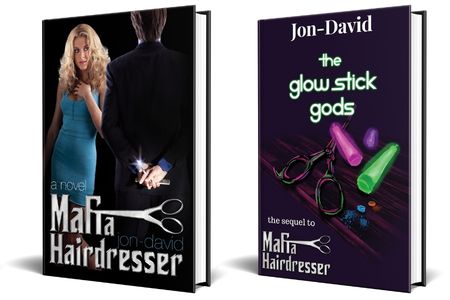
THE STORIES THAT STARTED IT ALL
Mafia Hairdresser, & The Glow Stick Gods – two outrageous novels of mobsters, Hollywood, celebrities, cocaine, “Tina”, rave culture, and survival. Inspired by Jon-David’s unbelievable life.
Discover the Books →

Age Has Changed the Questions I Ask
When I disagree with someone now, I’m more likely to ask myself questions Younger Jon-David rarely considered.
Does this actually matter?
Do I need to say something?
Am I trying to solve the problem or win?
Will what I’m about to say improve anything?
And the big one:
Even if I’m right, do I need to make this person wrong?
That last question could have saved me a lot of friendships.
Sometimes You Don’t Get the Friendship Back
Years later, I reached out to Allison.
I apologized.
I told her I loved her.
And for a moment, it looked as though perhaps we’d reconnect.
We even talked about having dinner.
Then another situation happened involving a mutual friend.
My intentions weren’t what Allison believed them to be.
But she interpreted my actions through the Jon-David she had known.
And suddenly I understood something painful.
I had taught her to think that about me.
Maybe her interpretation wasn’t fair to the person I had become.
But it made perfect sense based on the person I had been.
That’s a difficult bill to receive.
And unlike a restaurant check, you don’t get to argue about your portion.
People Experience Your Behavior, Not Your Intentions
We spend a lot of time defending ourselves with intent.
“I didn’t mean it that way.”
“That’s not what I was trying to do.”
“You misunderstood me.”
“My intentions were good.”
Sometimes all of that is true.
But relationships aren’t built solely from what happens inside your head.
They’re built from what another person repeatedly experiences from you.
If you’re dismissive twenty times and kind the twenty-first, you can’t demand that someone define you by number twenty-one.
If you’ve used your intelligence to make someone feel stupid, they may brace themselves the next time you offer “help.”
If you’ve controlled people in the past, they may see control even when you believe you’re merely making a suggestion.
That’s not necessarily their failure to understand the new you.
It may be the old you collecting interest.
An Apology Doesn’t Create an Obligation
This was another lesson.
You can apologize sincerely.
You can understand exactly what you did.
You can regret it.
You can change.
And the person you hurt still doesn’t owe you access to them.
They don’t owe you reconciliation.
They don’t owe you dinner.
They don’t owe you the opportunity to demonstrate your magnificent personal growth.
Sometimes the apology isn’t the beginning of a renewed relationship.
Sometimes the apology is simply the first decent thing you’ve done at the end of one.
That’s painful.
But I think it’s true.
So What Do You Do With Regret?
For a while, I thought the answer was to keep punishing myself.
Replay the dinner.
Remember Allison’s embarrassment.
Feel terrible.
Repeat.
Very productive.
Eventually I realized remorse is useful only if it changes your behavior.
Otherwise, you’re just making yourself the center of the story again.
Even your guilt becomes about you.
The better apology is:
Don’t do it to the next person.
Become somebody who wouldn’t behave that way today.
I Still Like Being Right
Let’s not get ridiculous.
I haven’t achieved enlightenment.
If you tell me something I know is factually incorrect, there is still a tiny lawyer inside my head standing up and buttoning his jacket.
“Your Honor…”
He’s still there.
I’ve just learned that he doesn’t need to take every case.
Somebody can be wrong at dinner.
The Republic will survive.
Someone can dislike something I love.
Fine.
A friend can make a decision I wouldn’t make.
Also fine.
And sometimes I can even realize halfway through an argument that I’m wrong.
I don’t enjoy those occasions.
But apparently they happen.
The Goal Isn’t to Become Passive
I don’t think personal growth means becoming someone who never disagrees.
There are times to speak.
Times to confront.
Times to defend yourself.
Times when truth matters enormously.
Kindness doesn’t require cowardice.
But neither does strength require cruelty.
That’s the distinction I didn’t understand when I was younger.
I thought the sharpest person in the room won.
Now I think the person who knows when not to cut might be smarter.
Maybe that’s the hairdresser in me.
I Don’t Remember the Tip
That’s what stays with me.
The entire argument began because I was so certain the numbers mattered.
Today I couldn’t tell you the numbers if my life depended on it.
I remember Allison.
Coffee.
Cigarettes.
Our dogs.
That park in Chicago.
Her wicked sense of humor.
Twenty years of friendship.
And one dinner where I decided being right was more important than being kind.
I wish I could change that night.
I can’t.
But I can finally understand it.
And perhaps that’s what wisdom actually is.
Not finally becoming right about everything.
But realizing how many things you once thought mattered…
didn’t.
I was right about the tip.
I was wrong about everything that mattered.
Listen to How I Killed My Mother
How I Killed My Mother is a memoir podcast about mothers and sons, depression and hope, family and forgiveness, caregiving, spirituality, humor, death, and the uncomfortable business of discovering who we really are.
The podcast also became the foundation for my upcoming memoir, How I Killed My Mother.
This isn’t a story about having all the answers.
It’s about what happened when I finally started asking myself the questions.
If you’re standing at the bottom of something right now, I can’t tell you how long your climb will be.
I can only tell you that I’ve stood at the bottom, too.
Climb with me.
— Jon-David
0 Comments